Motion Control – Maxon’s HPSC (High Performance Sensorless Control!)

Motion Control – Maxon’s HPSC (High Performance Sensorless Control!)

Maxon motor introduces HPSC sensorless speed and torque with compact wiring and slim design

motion control sensorless controller

Maxon Logo

Fall River, MA — Motion Control Components – Miniature – Maxon Motor has developed a sensorless speed and torque control solution called “HPSC”. This new technology allows FOC (field oriented control) for brushless motors without sensors from full stop to full speed under load. This HPSC uses a sophisticated signal injection algorithm which precisely determines the rotor position for a smooth startup each and every time.

  • Low noise, No vibrations
  • Maximum power efficiency
  • Robust and reliable

This system contains an HPSC module 24/5 – dimension and power range can be adapted if required. The firmware of the module may be customized for every drive system. HPSC is a custom made solution ideal for surgical systems, fluid delivery systems, rehabilitation & prosthetics. Contact maxon for more details info@maxonmotorusa.com

Comprehensive documentation and software are included with every delivery, and are also available for you to download from our website at www.maxonmotor.com.

Maxon Logo
Visit our Website
Order Our Catalog

Motion Control – Highly Efficient 2 Way Traction Drives Reduce Motor Torque Ripple up to 84%!

North Babylon, NY – Motion Control Components – Rolling Motion Industries (RMI) has released two new traction drives. The MAR-17-2-2.1 Traction Drive and the MAR-23-2-2.1 Traction Drive. These highly efficient 2-Way gearless traction drives with only six moving parts use an engineered traction fluid with a coefficient of friction of just 0.1 to 0.12. The MAR-17-2-2.1 and MAR-23-2-2.1 Traction Drives have demonstrated an up to 84% reduction in motor torque ripple when measured at the output shaft of the motor and then measures at the output shaft of the traction drive. The MAR17-2-2.1 Traction Drive is designed for speeds to 3600 rpm with 10 to 20 in/lbs of torque, and the MAR-23-2-2.1 Traction Drive is rated for 3600 rpm with 20 to 30 in/lbs of torque.

RMI Drives-Logo

Having no metal to metal contact these compact, high efficiency drives generate up to 72% less heat after 24 hours of continuous operation, and these permanently lubricated traction drives typically last three times longer than conventional gearboxes, They also create up to 38% lower dB at 3000 rpm than conventional gearboxes which is less than a typical home appliance. Even though there is no metal to metal contact there is no slippage or lost motion between the input and output shafts.

Operating at temperatures that are lower than a motor’s, with low vibration, and no torque losses from 10 to 3000 rpm, these traction drives permit a motor to operate at peak efficiency. Applications for these 2-Way traction drives which can operate in explosive environments (ie. zone 1 and 21) include: Medical (including patient handling), pharmaceuticals, wafer handling, robotics, conveyers, sorting, pumps, assembly, battery operated vehicles, and other power transmission and motion applications.

These revolutionary drives are available with an optional overriding clutch. Incorporating standard NEMA mounting dimensions, these drives can be easily integrated into new and existing applications.

About Rolling Motion Industries (RMI)-

About Rolling Motion Industries (RMI): In 1993 John Pawloski and his brother Ray took over the family business, Jewelers Machinist Co. They realized they needed to switch from outdated conventional thread grinders to CNC thread grinders. As a result, Jewelers Machinist Co is recognized as the source of some of the most complex thread grinding in the industry. The concept for the RMI traction drive came from John in 2007. Working in that high precision industry aided John in the development of the RMI Traction Drive.

In the years that followed, the design of the individual components and formula of the engineered traction fluid were finalized, testing was completed, a patent granted, and production begun. The RMI Traction Drive is one of the most efficient ways to transmit power from one point to another. Utilizing rolling motion, RMI is able to transfer power at various ratios with minimal energy loss. Tested against V-belt, direct drive, chain, and gearbox setups, RMI Traction Drives offer energy saving benefits through true efficiency rating percentages up to 98%. The high efficiency of the traction drive allows electric motors to run at their peak efficiency ranges.

There are many applications where it can be used from automotive to industrial to medical. The RMI traction drive can be used in the electric vehicle market and precision applications. Offering benefits such as low backlash and no back driving, it set a new standard for “high efficiency”.

For additional information contact our sales team at Rolling Motion Industries, 400 Columbus Ave, North Babylon, NY 11703 Tel 860-846-0530, E-Mail info@RMIDrive.com or visit the website at http://www.RMIDrive.com

RMI Drives-Logo
Visit our Website
About Rolling Motion Industries
RMI YouTube Videos

Motion Control – Linear Focus Actuator Features, 20 mm Clear Optical Path, <50 nanometer Repeatability, and <3 miliseconds Response Time!

Motion Control – Linear Focus Actuator

Forestville, CA –The LFA-2010 Linear Focus Actuator from Equipment Solutions is a high performance compact motion control positioner, specifically developed for optical applications requiring both high precision and high speed positioning over a short to medium stroke.

motion control - miniature components

The LFA-2010 actuator has a 10 mm range of motion with <50 nanometer positioning repeatability, and a small step response of time of <3 milliseconds. This high force, low noise voice coil motor is typically configured with an analog position feedback sensor and can be optionally equipped with a 1um resolution digital quadrature feedback element.

Motion Control – Miniature Spiral Bevel Gearboxes from Gam!

Motion Control – Miniature Spiral Bevel Gearboxes!

motion control - electromate robotics


Vaughan, Ontario, Canada — Motion Control Components – The VP Series Performance Plus miniature spiral bevel gearboxes pack high performance in a small package with the highest torque density, range of ratios, and torque capacity on the market.

Motion Control Application – Maxon Motor’s Exoskeleton Joint Actuator!

Motion Control – Application – Reliable, Powerful, Efficient

 motion control - Application - Exoskeleton Drive


motion control - Maxon Logo

Fall River, MA — Motion Control Components Application – Maxon Motor developed an exoskeleton drive for use in robotic limbs. This complete joint actuation unit consists of a pancake brushless DC motor with inertia optimized rotor. Also included is an internal high resolution encoder, planetary gearhead with absolute encoder and a position controller with CAN and RS232 interface. Fitting absolute encoder directly at the joint rotation provides designers increased positioning accuracy.

The unit delivers 54Nm of continuous torque and 120Nm on a 20% duty cycle and may be operated on supplies between 10 and 50V DC and the actuation speed is up to 22rpm. Other key features include: compact housing, integrated controller and reduced weight and cost. The ideal choice for use in Hip and Knee Exoskeletons.

Contact maxon for more details info@maxonmotorusa.com

Comprehensive documentation and software are included with every delivery, and are also available for you to download from our website at www.maxonmotor.com.

Maxon Logo
Visit our Website
Order Our Catalog

Motion Control handbook

The Engineering Edge – What’s the Difference?

Motion Control – Linear Bearings Compared

motion control - ceramic linear bearings
E. Longmeadow, MA – LM76’s high speed, “Black Racer,” ceramic coated linear bearings out perform linear ball bushing and linear polymer bearings in high speed and high acceleration/deceleration applications. These drop in replacement linear bearings are designed to be used in standard open and closed pillow blocks. “Black Racer” linear bearings are ideal for: Rocket sleds, crash test systems, and other high speed, high acceleration application.

Advanced Manufacturing and Materials Have Made an Innovative, Highly Efficient Traction Drive Possible!


RMI Drives-Logo

North Babylon, NY – Rolling Motion Industries (RMI) has released two high efficiency traction drives. The MAR-17-1-2.1 Traction Drive and the MAR-23-1-2.1 Traction Drive. These are 1-Way traction drives with only six moving parts and use an engineered traction fluid with a coefficient of friction of just 0.1 to 0.12. These traction drives typically last three times longer than conventional gearboxes and with no metal to metal contact these high efficiency drives generate up to 72% less heat after 24 hours of continuous operation, Additionally they create up to 38% lower dB at 3000 rpm (less than a home refrigerator) than conventional gearboxes. Even though there is no metal to metal contact there is no slippage or lost motion between the input and output shafts.

The MAR17-1-2.1 Traction Drive is designed for speeds to 3600 rpm with 10 to 20 in/lbs of torque, and the MAR-23-1-2.1 Traction Drive is rated for 3600 rpm with 20 to 30 in/lbs of torque. Operating at temperatures that are lower than a motor’s, with low vibration, and no torque losses from 10 to 3000 rpm, these traction drives permit a motor to operate at peak efficiency. Applications for these 1-Way traction drives which can operate in explosive environments (ie. zone 1 and 21) include: Pumps, blowers, fans, turbo and super chargers, conveyers, HVAC systems, medical applications, and other power transmission and motion applications.

These revolutionary drives are available with an optional overriding clutch. Incorporating standard NEMA mounting dimensions, these drives can be easily integrated into new and existing applications.

About Rolling Motion Industries (RMI)-

About Rolling Motion Industries (RMI): In 1993 John Pawloski and his brother Ray took over the family business, Jewelers Machinist Co. They realized they needed to switch from outdated conventional thread grinders to CNC thread grinders. As a result, Jewelers Machinist Co is recognized as the source of some of the most complex thread grinding in the industry. The concept for the RMI traction drive came from John in 2007. Working in that high precision industry aided John in the development of the RMI Traction Drive.

In the years that followed, the design of the individual components and formula of the engineered traction fluid were finalized, testing was completed, a patent granted, and production begun. The RMI Traction Drive is one of the most efficient ways to transmit power from one point to another. Utilizing rolling motion, RMI is able to transfer power at various ratios with minimal energy loss. Tested against V-belt, direct drive, chain, and gearbox setups, RMI Traction Drives offer energy saving benefits through true efficiency rating percentages up to 98%. The high efficiency of the traction drive allows electric motors to run at their peak efficiency ranges.

There are many applications where it can be used from automotive to industrial to medical. The RMI traction drive can be used in the electric vehicle market and precision applications. Offering benefits such as low backlash and no back driving, it set a new standard for “high efficiency”.

For additional information contact our sales team at Rolling Motion Industries, 400 Columbus Ave, North Babylon, NY 11703 Tel 860-846-0530, E-Mail info@RMIDrive.com or visit the website at http://www.RMIDrive.com

RMI Drives-Logo
Visit our Website
About Rolling Motion Industries
RMI YouTube Videos

Dyadic actuators are compact mechatronic cylinders that feature a motor, encoder, drive & actuator in one integral package!

Servo2Go-Logo

Greenville, DE —-Motion Control Components – Servo2Go.com has just added remarkable new additions to its broad range of cost-effective 24V electric linear actuators from Dyadic Systems. The SCN6 series actuators are compact yet powerful integrated mechatronic cylinders that feature a motor, encoder, drive and actuator in one integral package.

Dyadic Systems has developed the linear actuator drive mechanism such that the screw and nut are optimized for high accuracy, long life and low cost while delivering high speed and peak thrust. This blend of low-cost and high performance could only have been realized by the advanced technology of Dyadic Systems. These new product concepts give engineers a wider range of options to eliminate over-design.

SCN6 series Mechatronics Cylinders are available in strokelengths to 300mm and 500N (51kgf) maximum thrust and are constructed using an extruded aluminum body with 303 stainless for the shaft and rod tip. Actuators can easily be operated via 24VDC signals from PLCs or relays, and can be connected in networks of up to 16 axes. Servo Actuators from Dyadic feature:

  • Teach pendant, PLC pendant or PC Tool Kit programmable
  • +-0.1mm repeatability
  • 0.3mm backlash
  • 50-300mm stroke versions
  • Up to 200mm/sec max. speed
  • 16 discrete position program capacity
  • IP40 sealed, with optional IP54 sealing
  • Electric actuators – programmable in 15 minutes!
  • The SCN6 starts from only $465 US/ea!
  • Moves can be relative, absolute, force controlled, and more
  • All actuators run on 24VDC – easy to connect to your existing power supply!
  • Air cylinder replacement mode and move sequencing available in the cylinder!

For More for more information on the SCN6 Actuator from Dyadic Systems CLICK HERE!

Be Sure to visit the NEW Servo2Go Website! http://www.Servo2Go.com

These and other Motion Control Products are available through www.Servo2Go.com

For further information on this new product or others in our extensive product portfolio, call 1- 877-378-0240 or e-mail Warren Osak at warren@servo2go.com or visit Servo2Go.com at: www.Servo2Go.com

Servo2Go-Logo
Visit our Website
Twitter Link
Facebook Link

Motion Control – New POSITAL Sensors – Precision Feedback for Collaborative Robots Available from Electromate!

motion control sensors for robotics


Motion Control - Electromate-Logo

POSITAL Kit Encoder for Servomotors and Robots 

Vaughan, Ontario, Canada — Motion Control Components — A very exciting development in the area of robotics is the development and growing popularity of so-called collaborative robots, or “cobots”. Cobots, in contrast to traditional industrial robots, are designed to interact with human workers in a shared workspace. They are typically smaller and less powerful than traditional factory robots and are equipped with a variety of proximity sensors, load sensors and other features designed to avoid dangerous collisions between the robots and the people working around them. This focus on safety means that cobots are easier to deploy in a normal factory setting, since they don’t required special fenced off operating areas. Cobots have been used to perform repetitive tasks in light assembly, packaging, materials handling and medical laboratories. Cobots have also been used to help workers avoid direct contact with environments not conducive to direct human interaction, such as high temperature environments, chemically aggressive reagents and toxic pathogens.

Enabling Technologies for the Cobot Revolution

Motion Control robot with POSITAL Sensors

Many cobots are designed to mimic a human arm, with flexible “shoulder”, “elbow” and “wrist” joints. Accurate measurement of the rotary position of these joints is central to enabling the cobots’ control system to keep track of the spatial orientation of all of its moving parts. This is typically provided through rotary encoders mounted in each of the device’s joints.

Encoders measure rotation and return a digital signal that reports the angle of rotation (absolute encoders) or rate of motion (incremental encoders) to the control system. The ‘right’ encoders for cobots need to be accurate, reliable, and compact, with excellent dynamic response characteristics. They also need to be reasonably priced. POSITAL-FRABA has responded to this challenge by developing new sensing technologies – such as magnetic and capacitive rotary encoders – that provide cobot manufacturers vital feedback for closed-loop control systems. In order to ensure that these devices meet the needs of cobot builders, POSITAL-FRABA offers products with a wide range of performance characteristics, communications interfaces and physical configurations.

POSITAL‘s kit encoders offer a unique combination of accuracy, reliability and cost efficiency. Absolute measurement versions provide 17 bit electrical resolution and multiturn position measurements with a range of more than one million revolutions.

  • Electrical Resolution: Up to 17 Bit, Multiturn: Up to 32 Bit
  • Accuracy: 0.1°
  • Compact Size: 36 mm diameter, 24.2 mm Height
  • Operating Temperature: -40 to +105°C
  • Auto Calibration − No Complex Equipment
  • Extensive Diagnostic Coverage
  • Various Programmable Parameters
  • kit_render_001

Motion Control Sensors for Robotics


Advantages

POSITAL’s contact free measurement technology has no moving parts and is highly resistant to shock and vibration. POSITAL’s kit encoders are available with several non-proprietary electrical interfaces including BISS and SSI for absolute measurements. Additional protocols based on the RS485 interface can be implemented.

  • Absolute Multiturn & Incremental Interface
  • Electrical Interface: BiSS C, BiSS Line, SSI, RS485
  • No Battery – No Maintenance
  • No Ball Bearings & Compact Design
  • Insensitive to Dust and Moisture
  • High Shock and Vibration Resistance

Upgrade Your Existing Motion Control Application

Making your transition from incremental to absolute position sensing easy, POSITAL provides a full line of versions that are mechanical drop in replacement for common US Digital and Broadcom (Avago) incremental kit models.

  • Same Footprints as E5 and HEDS-5500 Models
  • Various Hub Diameters from 4 mm to 10 mm (and 1/4 to 3/8 inch)
  • Identical Assembly Procedure – No Training Required
  • Magnetic Technology Which Is Generally More Robust Than Optical
  • Improved Connectivity via M12 Connector Additional Available

CLICK HERE for additional information about POSITAL Kit Encoder for Servomotors and Robots.

About Electromate:

Electromate’s Core Purpose is to help Manufacturers build better machines using differentiated automation technology. They specialize in Robotic and Mechatronic Solutions for the Industrial Automation marketplace. Respected by customers as a premiere source for High Performance Automation and Motion Control Components & Systems, Electromate® specializes in AC & DC Servo and Stepper Motors & Drives, Motion & Automation Controllers, Positioning Systems & Actuators, Feedback Devices, Gearing Products and HMI’s & Operator Displays, all supported via extensive product selection, just-in-timedelivery, dedicated customer service and technical engineering support.

More on Electromate can be found at

Website: http://www.electromate.com

LinkedIn: https://www.linkedin.com/company-beta/209277/

Twitter: https://twitter.com/Electromate

Facebook: https://www.facebook.com/electromateindustrial/

Google+: https://plus.google.com/104057418684128701566

Blog: https://electromate.wordpress.com/

Electromate Best Blace to Work

For more information on the “Best Place to Work”CLICK HERE!

To view Electromate’s new corporate video CLICK HERE

For further information on this new product or others in our extensive product portfolio, call 1-877-SERVO99 (737-8699) or e-mail Warren Osak at sales@electromate.com or visit Electromate at: www.electromate.com


Motion Control - Electromate-Logo
Visit our Website
Motion Control - Electromate Twitter Link
Motion Control - Electromate Facebook Link

Motion Control – Maxon’s EPOS4 Motion Controller Expanded with EtherCAT!

Motion Control – Maxon motors introduces Plug-in board for maxon EPOS4 controllers. lug-in board for maxon EPOS4 controllers. Your drive specialist, maxon motor, is equipping its EPOS4 positioning controllers with additional connectivity options. They can now be integrated into any EtherCAT network as a slave by using an expansion board.

motion control - Maxon EtherCAT Plugin for EPOS4 Motion Controller


Maxon Logo

Fall River, MA – Motion Control Components -EtherCAT Plugin for Motion Controller – Your drive specialist, maxon motor, is equipping its EPOS4 positioning controllers with additional connectivity options. They can now be integrated into any EtherCAT network as a slave by using an expansion board

EPOS4 positioning controllers by maxon motor are now able to communicate via EtherCAT using the CoE standard (CAN application layer over EtherCAT). The EtherCAT card can be combined with the EPOS4 controllers in a housing, as well as with all EPOS4 modules. EPOS4 Compact designs with EtherCAT versions will follow at a later date. This expansion for the world of Ethernet-based communication protocols further expands the areas of application for the compact positioning controllers. For example, in applications where short cycle times are important in synchronized multi-axis systems.

Additional features and benefits.

EPOS4 controllers are suitable for controlling both brushed and brushless DC motors. They stand out for their high power density and excellent value. A range of additional services that facilitate easy installation are provided to the customers free of charge. This includes an intuitive user interface, libraries, and many application examples. For more information about our EPOS controllers, detailed product information is available in the maxon online shop: shop.maxonmotorusa.com

Comprehensive documentation and software are included with every delivery, and are also available for you to download from our website at www.maxonmotor.com.

Maxon Logo
Visit our Website
Order Our Catalog

Motion Control – High Precision, Low Profile, Motorized, Ball Bearing Linear Guide Stages!

Van Nuys, CA – — Motion Control – Optimal Engineering Systems, Inc. (OES) offers two series of low cost, low profile, motorized ball bearing linear guide (profile rail) positioning stages. The AQ140 Series and the AQ150 Series of linear stages are available off-the-shelf in travel lengths of: 50 mm (1.969 in), 100 mm (3.937 in), 150 mm (5.905 in), 200 mm (7.874 in), 300 mm (11.811 in), 400 mm (15.748 in), 500 mm (19.685 in).

motion control - stages - custom

These 2 µ resolution stages (achieved with a 10 micro-steps per step stepper motor driver) are ideal for: Laser machining, testing, pick-and-place, inspection, sorting, wafer handling, semiconductor, assembly, metrology, and photonics in industrial, laboratory, and medical applications.

The tables, depending on length of travel, measure 120 x 120 mm (4.73 in x 4.73 in.), 150 x 150 mm (5.90 in x 5.90 in.) and 160 x160 mm (6.30 in x 6.30 in.) The AQ150 Series has top and side rail covers. Featuring a 4 mm per turn, precision 2 µ backlash lead screw, typical performance specifications of the AQ140 and AQ150 linear stages include: repeatability of 5 µ, positional accuracy 8 µ, straightness 6 µ, driving parallelism 15 µ, pitching 25 arc seconds, and deflection 25 arc seconds.

Constructed of aluminum and black anodized, these stages can handle loads to 30 kg (66 lbs.) and 50 kg (110 lbs.). These low profile stages can easily be ordered in an XY or XYZ configuration. There is a knob on the back of the motor for manual adjustments or it can be replaced with an encoder. An optional servo motor, encoder, and brake are also available. These compact linear stages are easily integrated into new and existing systems and are available as with complete plug-and-play systems or with a plug-in motor driver. For details concerning each stage in the series please go to http://oesincorp.com/motorized-linear-stages/low-cost-series/index.htm

About OES – Optimal Engineering Systems, Inc. (OES) is a manufacturer of motion control products including: Stepper motor controllers and drivers, solenoid electronics, and positioning stages and slides. Applications include: Animation, automated assembly systems, automation, CNC machines, flight simulation, inspection systems, linear and rotary stages, machine tools, medical devices, motion control camera boom systems, optical comparators, CMMs, pan-tilt gimbals, PCB assembly & inspection, pick-and-place, positioning stages, robotics, scanners, security cameras, telescope drive mechanisms, time-lapse photography and winders.

Some of the industries OES serves are: Aerospace, Astronomy, Chemical, Communications, Educational Institutes, University, Colleges, Government Agencies, National Labs, Manufacturing, Medical, Metrology, Military, Motion Control, Museum, News Agencies, Semiconductor and Test Equipment. Optimal Engineering Systems, Inc’s. competitive advantage is its state-of-the-art in-house manufacturing facility in North America enabling OES to supply clients with custom designed orders or high volume just-in-time deliveries globally.

For additional information, contact sales team at: OES, 6901 Woodley Ave.; Van Nuys, CA 91406; Telephone: 888-777-1826 or +1 818-222-9200, FAX +1 818-436-0446 or E-Mail: sales@oesincorp.com or visit the website at http://www.oesincorp.com


See this and other Motion Control Components from OES (Optimal Engineering Systems, Inc.) featured on:

http://MotionShop.com.com

http://AllMotionBlogger.com

http://Automation-Blogger.com

http://MotionControlBlogger.com

http://motioncontrolBuyersGuide.com

http://MotionControlWeb.com

http://MotionShop.net

http://Catalogs-MotionControl.com

OES is on Facebook

OES is on Twitter

OES Videos

motion control -oes


Motion Control Components – New EtherCAT Drive from Galil Motion Control!

Motion Control – EtherCAT Slave Drive

motion control - electromate robotics


Vaughan, Ontario, Canada — Motion Control Components — The EDD-3701x EtherCAT slave drive joins Galil’s EtherCAT Family. This family has grown to include two EtherCAT masters and an I/O slave with both digital and analog I/O points. The EDD-3701x is a motor amplifier that operates in an EtherCAT distributed system where there are up to 32 slave drives and one master. It has a daisy chain topology using standard CAT5 Ethernet cables. The EDD-3701x can interface with Galil masters (DMC-500×0 and DMC-52xx0) for sophisticated applications or with TwinCAT® for very simple applications.

The Engineering Edge – Application – Trunnion Grinding Slide for Oil Field


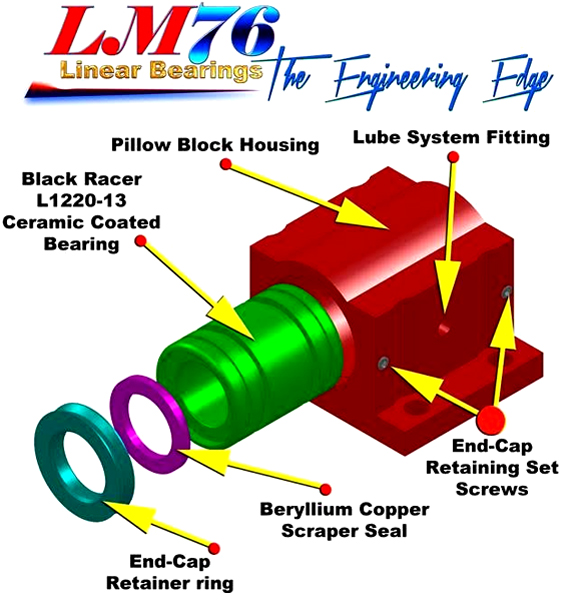
We are shipping another slide today for the oil patch. When Weir Oil and Gas called with a slide application that required special engineering, LM76 was all ears – as it was right up our alley. This slide is a Trunnion Grinding Slide which has a 56HP motor running at 3500 RPM mounted to the Y Axis – with a 12″ grinding wheel attached. The X Axis (52″ Stroke) runs on 440C stainless linear ball bearings that have special beryllium copper scraper seal cartridges while the Y Axis (4″ Stroke) employs profile rail guides with double scraper seal kits. Our customer did not want protective bellows so we had to ensure grinding debris would not cause bearing or screw/nut failures. On both axis, we employed our proprietary “Polymatrix, Double Preloaded Nuts” as opposed to recirculating ball nuts. Why LM76? Good question…we were the only company that got back to them with a thoughtful solution.

About LM76 and “The Engineering Edge”

Founded in 1976, LM76 has been a leading designer/manufacturer of linear bearings, slides and linear motion systems. LM76 is renowned for its industry leading Minuteman PTFE Composite linear bearings. LM76 is a leading supplier of precision linear shafting: RC60, 300 Series Stainless Steel, and ceramic-coated aluminum shafting. LM76 also offers several FDA/USDA compliant linear bearings and slides for the food processing, pharmaceutical, medical, and packaging industries.

When others think catalog …   … LM76 thinks solution!

For additional information contact Mike Quinn at: LM76, 140 Industrial Dr., E. Longmeadow, MA 01028; Telephone: 413-525-4166, Fax: 413-525-3735 or E-Mail: mquinn@lm76.com or visit the website at http://www.lm76.com

engineering edge directory link

LM76
Visit our Website
Order Our Catalog

Motion Control Application – Intelligent robot systems are increasingly being used in disaster control, rescue missions and salvage operations!

After the severe earthquake in Japan and the subsequent nuclear disaster in Fukushima, Quince managed to reach the upper floors of the ruins of the power plant. There it measured the radioactivity levels and sent HD images to the world outside.

Wherever it is too dangerous for humans. Robots that can look for survivors after an explosion, an earthquake or other natural disasters, providing humans with a view of inaccessible areas. Powerful EC motors from maxon motor give the Japanese rescue robot “Quince” its drive.motion control application robot Quince


Maxon Logo

Fall River, MA — Motion Control Components Application – Robots that are used in disaster areas have to have a very high level of adaptability. They have to be fairly small, not too heavy and maneuverable enough to get through cracks or narrow spaces to reach areas deep inside a building. Furthermore rough terrain should present no problem. These rescue robots enter and explore buildings to determine if there are gases, radiation or other life-threatening hazards, before human rescue teams can search the area. Quince has proven that it fulfills all these demands. After the severe earthquake in Japan and the subsequent nuclear disaster in Fukushima, Quince managed to reach the upper floors of the ruins of the power plant in June 2011. There it measured the radioactivity levels and sent HD images to the world outside (To see video – CLICK HERE). The robot was able to supply valuable information from areas where no human can set foot.motion control robot goes down stairs

Quince weighs 27 kg and is equipped with four moving caterpillar drives (flippers). These flippers automatically adapt their angular position to the surface underneath – regardless of whether the robot is climbing steep stairs or crossing rough terrain. Correct ground contact is a very important prerequisite. This contact is accurately analyzed by measuring the power consumption of the flipper motors. Furthermore PSD (Position-Sensitive Device) sensors on the front and rear flippers measure the distance to the ground. In addition to a gripper arm (see fig. 2), two laser scanners can also be attached to the robot. These scanners are capable of accurately capturing the structure of the terrain.motion control robot navigates rough terrain

Additionally Quince is equipped with a “bird’s eye camera” and can travel quite fast, at 1.6 meters per second. The operator that controls the robot has to tell it which direction to take, but the robot itself determines the optimal flipper positions for crossing various surfaces, for example stairs. Newer Quince motors have additionally been equipped with a device for collecting radio-active dust or ultra-fine particles, as well as a 3D scanner. To ensure that no robot is lost, a connection to a wireless network is possible, which is the only way to navigate the robot if the connection cable breaks.

The rescue robot was developed by Eiji Koyanagi, Vice-Director of the Chiba Institute of Technology Future Robotics Technology Center (fuRO). Koyanagi started his career as a teacher – at the age of 51, he became a professor. This means that he has a completely different background than other researchers in the field of robotics. Quince has been specially designed for extreme conditions in environments where it would be too dangerous for humans. Therefore its main area of application is disaster areas. “When you develop a robot, you first have to consider the tasks that it will perform later. That is the biggest challenge,” explains Koyanagi. Hitherto eight Quince robots have been built. But before this could be done, all components had to be 100% functional. To this end, various trials were run in the large “Disaster City” training area in College Station, Texas. Quince was the only robot that successfully completed the entire obstacle course at the site as part of a RoboCup contest. In preparation for using the robot inside the Fukushima Daiichi nuclear power plant, several specific customizations were required. “The conditions in the nuclear reactor buildings are very tough. If we had attempted to send Quince in without modifications, it would probably have met its end,” says Koyanagi. Therefore the robot had to be able to survive a fall from approx. 2 m high unscathed, and had to be largely maintenance-free.

Powerful motors to beat every obstacle

Motion Control -Maxon Motors used in robot Quince

Where the motor selection was concerned, fuRO required absolutely reliable drives. The motors have to provide high power and high efficiency, yet be small and light. These requirements were precisely met by maxon motors, explains Koyanagi. Six powerful maxon motors drive the robot. The brushless EC-4pole 30 direct current motors each provide 200 W; two of these have been installed in the two main chains. The powerful 4-pole units give their all when Quince maneuvers its way across uneven terrain. Four additional motors (EC22) drive the moving chain drives (flippers). These can automatically adapt their angular position to the surface below. The 3D scanner unit of Quince is moved to the right position by an RE-max 24. Thanks to the special winding technology and the 4-pole magnets, the maxon EC-4pole drives are unbeatable when it comes to delivering the highest driving power per unit of volume and weight. The motors have no cogging torque, high efficiency, and excellent control dynamics. The metal housing additionally ensures good heat dissipation and mechanical stability. All motors of the chain drives have been combined with the GP32HP (High Power) planetary gearhead with MR encoder. This gearhead was customized by installing a large ball bearing and a reinforced motor shaft. With this power pack, Quince has no trouble managing almost any obstacle.

Contact maxon for more details info@maxonmotorusa.com

Comprehensive documentation and software are included with every delivery, and are also available for you to download from our website at www.maxonmotor.com.

Maxon Logo
Visit our Website
Order Our Catalog

Motion Control – Power-Off Brakes for NEMA 17 & NEMA 23 Servo and Step Motors!

Motion Control – Power-off Brakes

motion control servo brake

motion control - electromate robotics


Vaughan, Ontario, Canada — Motion Control Components – The MPC is a power-off brake module with an output shaft. The unit mounts directly on to a NEMA C-Face servo or stepper motor and the output can also be coupled to a NEMA C-Face gear reducer. This brake is designed to decelerate or hold an inertial load when the voltage is turned off. When voltage is applied, the friction disc is released and the brake is free of torque. This power-off brake is best suited for parking brake applications used to hold a load in position, and is ideal for creating brake motor packages for small servo & stepper frame motors. Key Features:

  • Mounts directly to any NEMA 17 or NEMA 23, frame servo or step motor
  • Includes all necessary mounting hardware
  • 12VDC, 24VDC, 90VDC or 120VAC windings available
  • 12″ lead wire termination
  • Low current consumption
  • Output shaft can be coupled to any NEMA 17 or NEMA 23, frame servo or step motor
  • Optional metric input & output diameters

More information on these New Motion Control Power-Off Brakes for NEMA 17 & NEMA 23 Servo and Step Motors available from Servo2Go.com can be viewed at: https://www.electromate.com/media/assets/catalog-library/pdfs/inertia-dynamics/Inertia_Dynamic_TypeMPC_Specsheet.pdfThese and other Motion Control Products are available through www.Electromate.com

More on Electromate can be found at

Website: http://www.electromate.com

LinkedIn: https://www.linkedin.com/company-beta/209277/

Twitter: https://twitter.com/Electromate

Facebook: https://www.facebook.com/electromateindustrial/

Blog: https://electromate.wordpress.com/

motion control -innovation award


For more information on the “Innovation and Technology Award”

CLICK HERE!


motion control - components


For more information on the “2021 Excellence Award”

CLICK HERE!


motion control - products


For more information on the “Best Place to Work” CLICK HERE!


For more information on the “AHTD Award” CLICK HERE!


To view Electromate’s new corporate video CLICK HERE

For further information on this new product or others in our extensive product portfolio, call 1-877-SERVO99 (737-8699) or e-mail Warren Osak at sales@electromate.com or visit Electromate at: www.electromate.com


See this and other Motion Control Components from Electromate featured on:

http://MotionShop.com

http://LinearMotionBlogger.com

http://AllMotionBlogger.com

http://Automation-Blogger.com

http://MotionControlBlogger.com

http://MotionControlBuyersGuide.com

http://MotionControlWeb.com

http://MotionShop.net

http://Catalogs-MotionControl.com

http://MotionControlMarketing.com

http://Gotcha-Stick.com

Motion Control - electromate robotics

“New Design” Pillow Blocks from LM76!

Engineering edge - new design pillow block

When our customer, a major European manufacturer of machinery for the paper industry, informed us they were having failures with linear bearings in their robotic paper slicing system, we listened. As a robotic arm swings around (360 degrees) it slices the paper to length.

Motion Control – Maxon’s New EPOS Programmable Smart Drive/Controller – “Positioning Made Easy” are Available from Electromate!

Motion Control EPOS Controllers


Motion Control - Electromate-Logo


Vaughan, Ontario, Canada — Motion Control Components — EPOS is a modular, digital positioning controller by maxon motor. It is suitable for controlling permanent magnet-activated motors with encoders in a range of 1 to 1050 W continuous output power. The wide range of operating modes, as well as various command interfaces, make it versatile for use in many different drive systems in the fields of automation technology and mechatronics

With the EPOS4 Compact 50/8 EtherCAT and EPOS4 Compact 50/15 EtherCAT, maxon launches the first compact devices compatible with the fast industrial Ethernet connection EtherCAT. The fully integrated, plug-and-play positioning controller in a compact design is perfectly suited for use in networks with cycle times up to 1 ms.

Powerhouse with excellent control characteristics

The functionality, operation, software, and accessories of the new controllers are derived directly from existing products in the EPOS4 range. The devices are suitable for use with both brushed DC and brushless EC motors (BLDC) and come with comprehensive feedback options such as Hall sensors, as well as incremental and SSI absolute encoders. State-of-the art concepts such as FOC, feed forward, and observer control allow optimal control in a wide variety of applications.

Comprehensive functional scope and easy operation

The existing digital and analog inputs and outputs are freely configurable and ideally matched to the numerous functions and operating modes of CiA-402 positioning controllers. Products are set up using the EPOS Studio graphical user interface (Version 3.4 and higher) for Windows PCs. In addition to the intuitive commissioning software, Windows DLL and Linux Shared Objects libraries are freely available to make integration into a wide variety of master systems as easy as possible.

Motion Control - Maxon EPOS Controllers
Electromate offers Maxon EPOS Controllers

About Electromate:

Electromate’s Core Purpose is to help Manufacturers build better machines using differentiated automation technology. They specialize in Robotic and Mechatronic Solutions for the Industrial Automation marketplace. Respected by customers as a premiere source for High Performance Automation and Motion Control Components & Systems, Electromate® specializes in AC & DC Servo and Stepper Motors & Drives, Motion & Automation Controllers, Positioning Systems & Actuators, Feedback Devices, Gearing Products and HMI’s & Operator Displays, all supported via extensive product selection, just-in-timedelivery, dedicated customer service and technical engineering support.

More on Electromate can be found at

Website: http://www.electromate.com

LinkedIn: https://www.linkedin.com/company-beta/209277/

Twitter: https://twitter.com/Electromate

Facebook: https://www.facebook.com/electromateindustrial/

Google+: https://plus.google.com/104057418684128701566

Blog: https://electromate.wordpress.com/

Electromate Best Blace to Work

For more information on the “Best Place to Work”CLICK HERE!

To view Electromate’s new corporate video CLICK HERE

For further information on this new product or others in our extensive product portfolio, call 1-877-SERVO99 (737-8699) or e-mail Warren Osak at sales@electromate.com or visit Electromate at: www.electromate.com

Motion Control - Electromate-Logo
Visit our Website
Motion Control - Electromate Twitter Link
Motion Control - Electromate Facebook Link

Motion Control – High Performance Ultra Compact Stepper Motor Positioning Stage From Equipment Solutions!

motion control miniature stage


Foretville, CA, – — The motion control SMS12 Linear Stepper Motor stage is an ultra compact stage that provides up to 12 millimeters of linear motion. This stage offers near sub-micron resolution with the ability to accelerate a small load at 2G’s. A non-contact home sensor provides a reference position with repeatability of a couple microns. It was specifically developed for optical applications requiring both high precision and modest-speed positioning over a short to medium stroke. The SMS12 is well suited for optical focusing and other micropositioning applications such as scanning interferometry, surface structure analysis, disk drive testing, autofocus systems, confocal microscopy, bio-technology, semiconductor test equipment.


Specifications:

  • Translation 43µm/step
  • 0.67µm @ 64µstep/step
  • Maximum Travel 12mm
  • Maximum Acceleration 2G
  • Maximum Velocity 250mm/sec
  • Maximum Load Capacity 13kg
  • Maximum Moment Load 1.8kg
  • Positioning Accuracy ±2µm
  • Bidirectional Repeatability ±1µm
  • Homing Repeatability ±1µm
  • Motor Amps/Phase 0.3
  • Dimensions 39.1 x 39.1 x 31.75mm

The SMS12 can be ordered with an optional stepper motor controller that is nearly the same size a the SMS12 itself. Only raw power and a simple RS232/RS485 communications line is needed to completely control this high-resolution stage.

motion control - SMS-12 Stepper Motor Stage

Equipment Solutions, Inc. (ESI) is a provider of engineering and manufacturing services. ESI specializes in the design and production of automation and instrumentation products including motion control components and sub systems. ESI’s products range from galvanometer amplifiers with an integrated arbitrary waveform generator, to high-resolution displacement sensors, voice coil and stepper motor stages, amplifiers and controllers.

To view and/or down load the Data Sheet CLICK HERE

For additional information contact Jeff Knirck at Equipment Solutions,Inc. Mailing Address – PO Box 159, Forestville, CA 95436; Shipping Address 6490 Front Street, Forestville, CA 95436; Tel: 408-245-7162, Fax: 408-245-7160, E-Mail: info@equipsolutions.com or visit the Website at http://www.equipsolutions.com

Equipment Solutions
Visit our Website
Motion Control - Follow Equipment Solutions on Twitter
Motion Control - Follow Equipment Solutions on Facebool
View Equipment Solutions Motion Control Blog


See this and other Motion Control Components from Equipment Solutions are also featured on:
http://MotionShop.com
http://AllMotionBlogger.com
http://Automation-Blogger.com
http://MotionControlBlogger.com
http://motioncontrolBuyersGuide.com
http://MotionControlWeb.com
http://MotionShop.net

Motion Control Tutorial – Slotted vs. Slotless Motor Technology

motion control Servo2Go-Logo

When first introduced, brushless DC motors, despite their many advantages, were cast as a costly alternative to brush-commutated motors and were typically only specified for low-power applications where long life was the primary desired requirement. Without the mechanical brush-commutator mechanism that would wear and eventually result in motor failure, brushless motors could be relied upon to deliver performance over time. As for other advantages, conventional wisdom held that brushless motors provide high speed and fast acceleration, generate less audible noise and electromagnetic interference, and require low maintenance. Brush-commutated motors, on the other hand, would afford smooth operation and greater economy. In the past decade, though, brushless motors have gained broader appeal and greater acceptance in industry for a wider range of applications previously dominated by brush-commutated products, due in part to dramatic reductions in the cost and size of electronic components and advances in motor design and manufacturing.

At the same time, manufacturers have further sought to challenge conventional wisdom by improving brushless motor design in an effort to combine the traditional advantages of brush-commutated and brushless types. A noteworthy example of how far these innovations have progressed involves the slotless (instead of slotted) construction of the brushless motor’s stationary member, or stator.

The slotless stator design originated with the goal to deliver smooth running performance and eliminate cogging, which is an unwanted characteristic especially in slower-running applications (less than 500 rpm). The absence of cogging is, in fact, the most-often cited reason for selecting a slotless brushless motor.

Slotted Motor Construction

Most brushless motors (slotted or slotless) use electronic commutation, usually Hall-effect sensors and magnets, in place of brushes. The motor’s rotor consists of a steel shaft with permanent magnets or a magnetic ring fixed around the circumference of the shaft. The magnets are responsible for producing torque. As the flux density of the magnet material increases, the amount of torque available from the rotor assembly increases.

In traditional slotted brushless motors, the stator features a group of slotted steel laminations (0.004 in. to 0.025 in. thick), which are fused to form a solid uniform stack and create a series of teeth. Wound copper coils, which produce electromagnetic fields, are then inserted into each of the slots. Together, the laminated stack and wound copper coil form the stator assembly. The return path completing the magnetic circuit consists of the laminated material outboard of the copper windings in the stator and the motor housing.

These brushless slotted motors are especially powerful, because the teeth around which the copper wire is wound place the iron closer to the magnets, so the magnetic circuit is completed more efficiently. As the air gap between iron and magnets is reduced, the torque available for the motor is increased.

However, slotted stators are known to cause cogging, which is attributed to the teeth in their construction. Cogging occurs when the permanent magnets on the rotor seek a preferred alignment with the slots of the stator. Winding copper wires through the slots tends to increase this effect. As magnets pass by the teeth, they have a greater attraction to the iron at the ends of the teeth than to the air gaps between them. This uneven magnetic pull causes the cogging, which ultimately contributes to torque ripple, efficiency loss, motor vibration, and noise, as well as preventing smooth motor operation at slow speeds. A slotless stator offered a solution to the problems experienced with cogging in slotted brushless DC motors.

Advantage of the BLDC Slotted Motor Technology

The main advantages of the slotted technology are:

  • ease of winding customization
  • increased heat dissipation
  • ability to withstand high peak torque
  • high power density

Slotted Motor Applications

The Slotted Motor is ideal for applications such as:

  • Medical Hand Tools
  • Hand held shaver system for arthroscopic surgeries
  • High speed surgical drills for ENT surgeries

Slotless Motor Construction

Instead of winding copper wires through slots in a laminated steel stack as in conventional slotted brushless motors, slotless motor wires are wound into a cylindrical shape and are encapsulated in a hightemperature epoxy resin to maintain their orientation with respect to the stator laminations and housing assembly. This configuration, which replaces the stator teeth, eliminates cogging altogether and results in desired quiet operation and smooth performance.

The slotless design also reduces damping losses related to eddy currents. These currents are weaker in a slotless motor, because the distance between the laminated iron and magnets is greater than in a slotted motor.

Slotless motors are typically designed with sinusoidal torque output that produces negligible distortion, rather then a trapezoidal voltage output. The sinusoidal output reduces torque ripple, especially when used with a sinusoidal driver. Because the slotless design has no stator teeth to interact with the permanent magnets, the motor does not generate detent torque. In addition, low magnetic saturation allows the motor to operate at several times its rated power for short intervals without perceptible torque roll-off at higher power levels.

Compared with slotted motors, slotless construction also can significantly reduce inductance to improve current bandwidth. The teeth in a slotted motor naturally cause more inductance: the coils of copper wire around the teeth interact with the iron in a slotted motor, and this interaction tends to send the current back on itself, resulting in more damping (or dragging) and impacting negatively on slotted motor response and acceleration.

In terms of delivering power, conventional slotted motors used to enjoy the advantage over slotless types, due (as noted) to the proximity of iron and magnets and the reduced air gap.

However, this advantage has virtually evaporated, in large part due to the utilization of high-energy, rare-earch magnets (such as samarium cobalt and neodymium iron boron). By incorporating these magnets, manufacturers of slotless brushless motors have been able to routinely compensate for the greater air-gap distance. These more powerful magnets effectively enable the same (or better) torque performance for slotless products compared with slotted. Eliminating the teeth and using stronger magnets both serve to maximize the strength of the electromagnetic field for optimum power output. Rare-earth magnets, along with the fact that fewer coils, or “turns,” of the wire are required in slotless motors, also help contribute to low electrical resistance, low winding inductance, low static friction, and high thermal efficiency in slotless motor types.

One more important difference between slotless and slotted designs is the rotor diameter. Slotless motors have a larger rotor diameter than slotted construction for the same outside motor diameter and will generate a higher inertia, as well as accommodating more magnet material for greater torque. For applications with high-inertia loads, the slotless product is more likely to be specified.

Slotless Motor Applications

In general, brushless motors are usually selected over brushcommutated motors for their extended motor life. (While motor life is application-specific, 10,000 hours are usually specified.) Other reasons for specifying brushless motors include a wide speed range, higher continuous torque capability, faster acceleration, and low maintenance.

In particular, slotless versions of brushless DC motors will suit those applications that require precise positioning and smooth operation. Typical niches for these motors include computer peripherals, mass storage systems, test and measurement equipment, and medical and clean-room equipment.

As examples, designers of medical equipment can utilize slotless motors for precise control in machines that meter and pump fluids into delicate areas, such as eyes. In medical imaging equipment, slotless brushless DC motors decrease banding by providing the smoother operation at low speeds. Airplane controls supply smoother feedback to pilots. And, by eliminating cogging and resulting vibration, these motors can reduce ergonomic problems associated with hand-held production tools. Other appropriate applications include scanners, robots for library data storage, laser beam reflector rotation and radar antenna rotation equipment, among many others./span)

Customization Options

Slotless brushless DC motors, as with most motors today, feature a modular design so they can be customized to meet specific performance requirements. As examples, planetary or spur gearheads can be integrated on motors for an application’s specific torque and cost requirements. Planetary gearheads offer a higher-torque alternative. Slotless motors can further be customized with optical encoders, which provide accurate position, velocity, and direction feedback that greatly enhances motor control and allows the motors to be utilized in a wider range of applications. As a low-cost alternative to optical encoders, rotor position indicators (ie. Hall Sensors) can be specified.

When using optical encoders, differential line drivers can be utilized to eliminate the effects of electrically noisy environments. Differential line drivers are designed to ensure uncorrupted position feedback from the encoder to the control circuit.

Motor Selection Guided by Application

Despite the overall design and performance comparisons reviewed here for slotless and slotted brushless DC motor types, one should remain cautious in drawing any conclusion that one type is the ultimate choice over the other. There are simply too many variables that must be evaluated, ranging from rotor size and windings to housing and special components. A given application and its requirements should (and will) be the guiding factors in selecting a particular motor type and the customized components to be incorporated.

Some encouraging news in those applications that would clearly benefit from a slotless brushless motor is that costs are coming down to be more in line with those for slotted motors. This is because of new streamlined manufacturing techniques and an increasingly available supply of powerful magnets, which are both beginning to have a positive impact on end-product costs.

Regardless of any cost differential, however, for many applications, slotless brushless DC motors will be the preferred choice to resolve specific requirement issues. While advances in electronics are beginning to be applied that promise to reduce normal cogging in slotted products as a step toward making these motors more smooth running and quiet, the industry is not there yet: slotless motors remain the best alternative where cogging and life are defining performance issues


This Tutorial and other Motion Control Tutorials are available through www.Servo2Go.com

For further information on this new product or others in our extensive product portfolio, call 1- 877-378-0240 or e-mail Warren Osak at warren@servo2go.comor visit Servo2Go.com at: www.Servo2Go.com

Servo2Go-Logo
Visit our Website
Twitter Link
Facebook Link

Motion Control – ENX 16 RIO Encoder from Maxon Motor!

Motion Control – Maxon Motor presents a top-of-the-range high-resolution encoder. The ENX 16 RIO offers an impressive resolution of up to 65,536 counts per turn in a compact and rugged housing.

Motion Control - Maxon motion ENX 16RIO Motion Control Encoder


Maxon Logo

Fall River, MA –Motion Control Components – Miniature Encoders – Requirements on encoders are becoming more and more demanding. This applies particularly to positioning applications with precision constant-speed control, where increasingly compact housings need to accommodate an ever greater number of electrical contacts. maxon motor solves this problem with its new ENX 16 RIO optical encoder. It is a mere 16 millimeters in size and offers a resolution of up to 65,536 counts per turn, making it ideal for the precise position and velocity control of DC motors

The new maxon ENX 16 RIO encoder (Reflective, Interpolated, Optical) fulfills all the requirements for a high-resolution optical encoder in a compact design. The resolution can be configured at the factory or online. With 16 millimeters outer diameter and 7 millimeters overall length, the housing is mechanically robust and protected from dust due to its injection-molded construction. The operating temperature range is -40 °C to +100 °C.

Maxon motion ENX 16RIO Motion Control Encoder on Motor

Easily configured online for combinations with maxon motors

The encoder can be combined and configured with matching drives online. It fits the new brushless EC-i 30 motors and the brushed DCX motors (diameters of 16 millimeters and up). The counts per turn and the electrical interface of the ENX 16 RIO encoder are also configurable online. All combination options and detailed product information is available in the maxon online shop: shop.maxonmotorusa.com

Comprehensive documentation and software are included with every delivery, and are also available for you to download from our website at www.maxonmotor.com.


Maxon Logo
Visit our Website
Order Our Catalog